This street was far too posh for my battered VW. I noticed it immediately, before I’d even killed the engine. My first F1 job in community psychiatry had already proved a mixed bag, but it would be hard to surpass being taken hostage by a psychotic Aston Villa fan on my very first day. At the time, I was working for a small—chronically underfunded—early intervention service in The Midlands. Among my duties was roaming phlebotomy: taking blood from patients newly started on clozapine. I shut the car door, retrieved the Lucozade bottle pressed into service as a sharps bin (a relic of a Tesco meal deal), and scanned the neat facades for my patient’s front door. Damn budget cuts.
There were too many cats outside it. Lined up on the step, coiled in flowerbeds, perched on wheelie bins. I wondered about the collective noun—clowder, glaring—while calculating how many cats constituted a safeguarding concern. Two felt manageable. Three unsettling. Ten was surely excessive by any metric. Before I could settle on a number, the door opened, and I was waved inside.
The living room was in blackout. Curtains drawn. Lights off. A violent slasher flick pulsed on the plasma TV, arterial spray lighting the walls in lurid red. I glanced around for the hidden camera and was quietly disappointed.
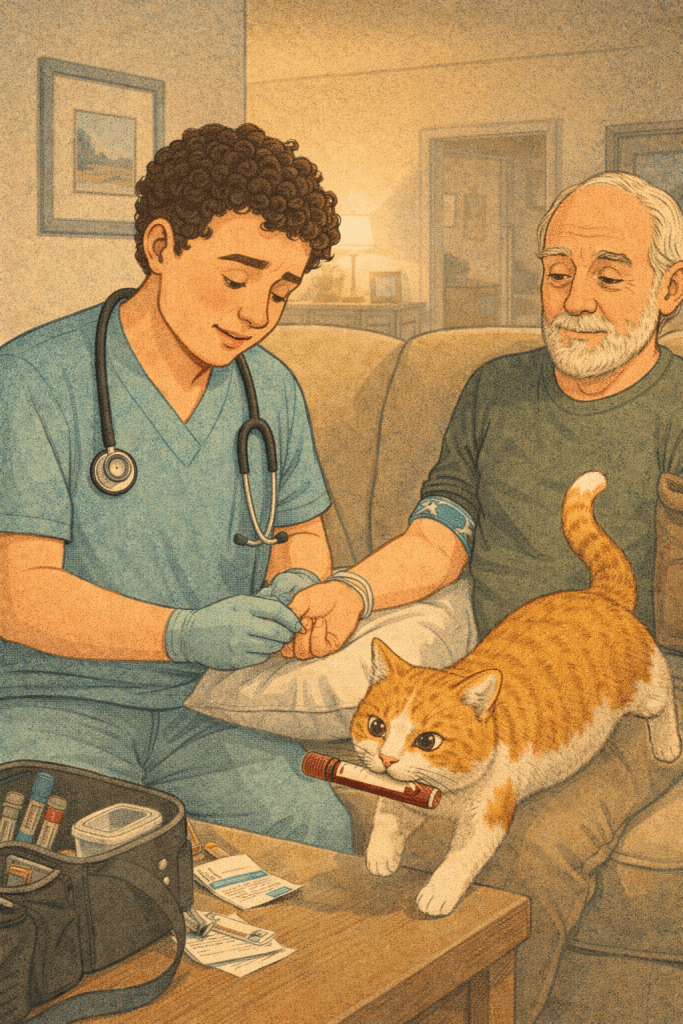
The phlebotomy itself was mercifully straightforward. I sealed the vacutainer into its specimen bag and leaned forward on the sofa to say my goodbyes. That was when an orange streak shot across my peripheral vision. There was a sharp tug at my right hand. I turned just in time to see an orange cat exiting the room at speed, the patient’s blood clenched triumphantly in its jaws.
What followed was less a pursuit than a humiliating scramble: up the stairs, into the parents’ bedroom, me slipping in my sensible shoes while the cat vaulted furniture with balletic ease. Eventually, after a brief but undignified struggle, I managed to prise the sample from its mouth. I left shortly afterwards, in a thick, awkward silence, carrying the bag at arm’s length.
Later that day, I dropped the samples at the hospital’s laboratory. The receiving technician held the bag up to the light, noted the constellation of tiny puncture marks, and hesitated. Then she shrugged, thanked me, and slid it into the tray. I left slightly amused in the knowledge that somewhere in the NHS there was almost certainly a form for this—and that neither of us had the time to fill it in.
 Life, death and everything in-between: Foundation doctor stories
Leave a comment