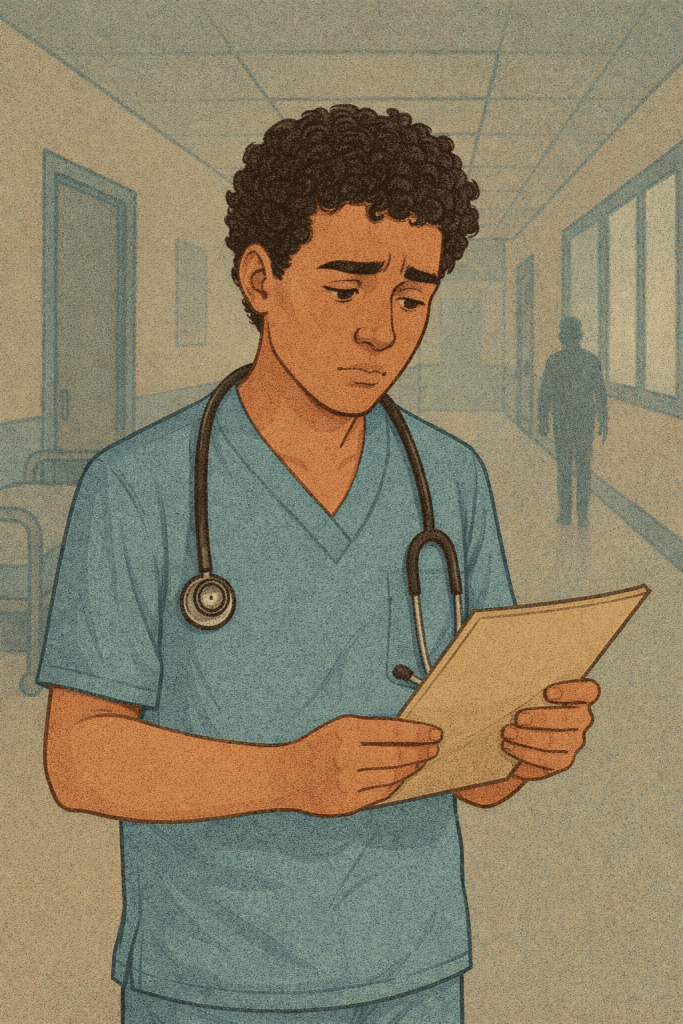
They arrived just after midday, pushed through double doors and onto our ward.
The bed came first, then the oxygen cylinder, then the man himself: small inside the sheets, eyes half-open, as if he’d already decided not to look too closely at where he’d ended up. Behind him walked his wife and two adult children, their faces tight with the kind of anger that has nowhere left to go.
I had been warned.
“Family escalated to NHS England,” the nurse said quietly. “They’re not happy.”
As if anyone ever is, when someone they love is dying.
He had come from another ward, one with fewer staff who are also more junior. By the time he reached us he was dehydrated, confused, his skin marked with the
beginnings of pressure damage. None of it dramatic enough to be a scandal. All of it enough to feel like neglect.
They took me aside almost immediately.
“Why was he left like that?” his daughter asked. “Why did no one come when we
rang the bell? Why did no one tell us he was getting worse?”
There it was the question I could never answer properly.
I could have blamed capacity. Or acuity. Or the winter pressures that had been
stretching everyone thin for months. I could have used the soft language of the
system: resource limitations, high demand, unexpected deterioration.
But all they wanted was the truth, and the truth was uglier.
“I’m sorry,” I said. “It sounds like he didn’t get the care he should have had.”
Her eyes filled instantly. Not because she was surprised, but because someone had
finally said it out loud.
“He kept saying he was thirsty,” she whispered. “We kept asking for help.”
I nodded, because there was nothing else to do. I wasn’t there. I didn’t see it. But I
believed her.
We moved him into a side room. Fresh sheets. A proper assessment. Fluids,
comfort, attention, and TPN. Things that suddenly became possible now that he was visible in the right place.
His wife stood by the bed, touching his hand as though trying to remind him where he was.
“Is he going to be okay now?” she asked me.
I wanted to say yes. I wanted to give them something solid to hold onto. But
medicine had already taken too much from them to offer a lie.
“We’ll do everything we can,” I said instead. “And we’ll make sure he’s comfortable.”
Later, I wrote the transfer note. Objective. Neat. A few lines to summarise days of
slow, quiet failure didn’t write about the daughter’s voice breaking when she realised she hadn’t imagined it.
I didn’t write about the way his wife kept smoothing the sheet, as if order could be
restored by small, careful movements.
I didn’t write about how it felt to stand there, apologising for a system I was only just learning how to survive inside.
But I carried it anyway. Because sometimes being a doctor doesn’t mean knowing
what to do; it means being the one who has to stand in the room when someone
finally asks why it went wrong.
 Life, death and everything in-between: Foundation doctor stories
Leave a comment